backyard stones course lawn

How To: Build A Backyard Stones Course

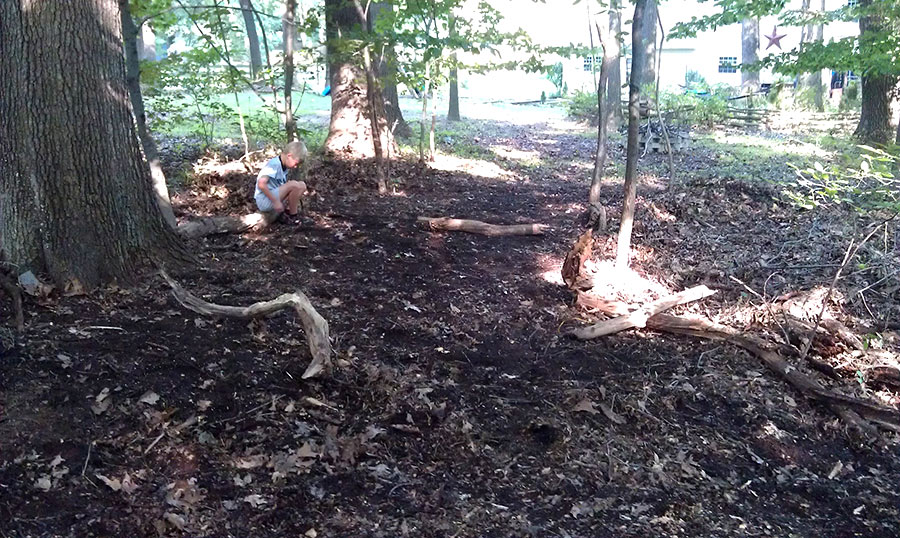
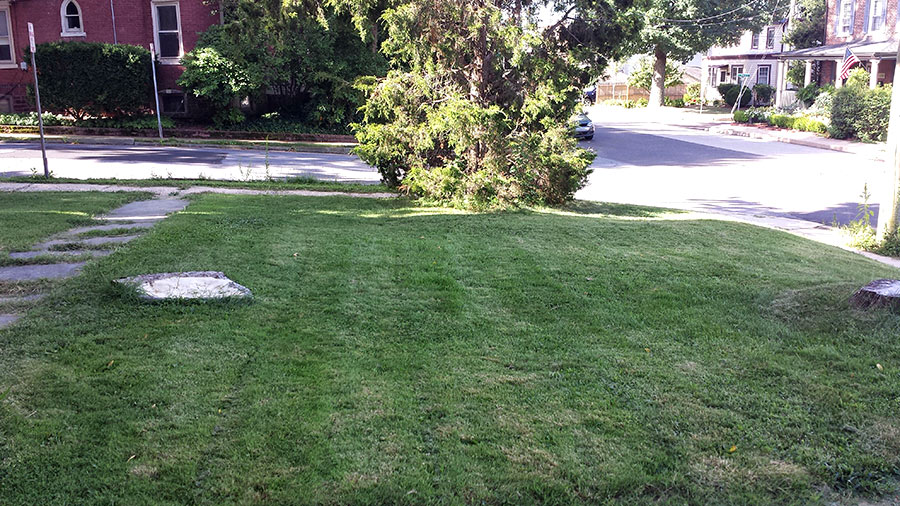
You don’t always need to come out to a public course if you wish to play or practice the game of Stones. Some of the best courses are made in backyards. Whether you have a two acre wooded lot, a small city lawn, or somewhere in between, the principles of building a course are the same.  If you follow a few key steps and have some imagination, you will be able to hone your skills at home.

Let’s first address what you’ll need:

  1. Stones—Self-explanatory. It would be difficult to play without them.
  1. Rake—Whether you’re working with grass, dirt, woods, beach, or any combination of the above, you’ll need to clean up the area.
  1. Borders—Every stretch will need to have borders. What you decide to make them out of is entirely up to you. Most borders are made with natural materials: logs, branches, trees, or rocks, but if you don’t have any of these available, be creative. People have used water, marking paint, dug trenches, or simply raked the leaves to the side and used them to indicate the boundary. No matter what material you choose, it’s imperative to make sure you can identify if a stone is in or out.

We have our items ready, so now let’s go build a course. An official Stones course has five stretches and one x-hole. This doesn’t mean your home course has to be the same. If you’re pressed for space, it would be better to make two or three well-designed stretches than to squeeze in five that were poorly-planned. One backyard Stones course in Mount Airy has three stretches—you just play stretches one, two, and three first, and then play three and two backwards. The key is to be creative and use what the land gives you.

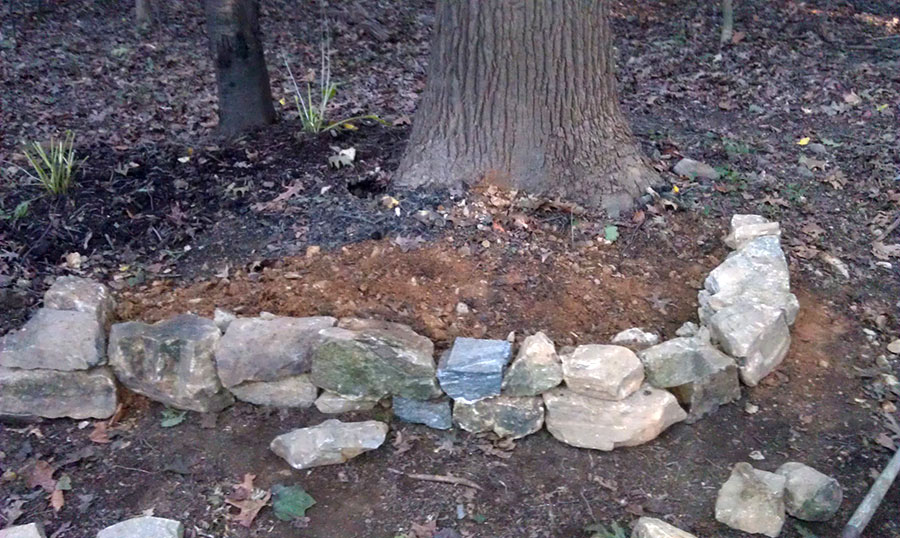
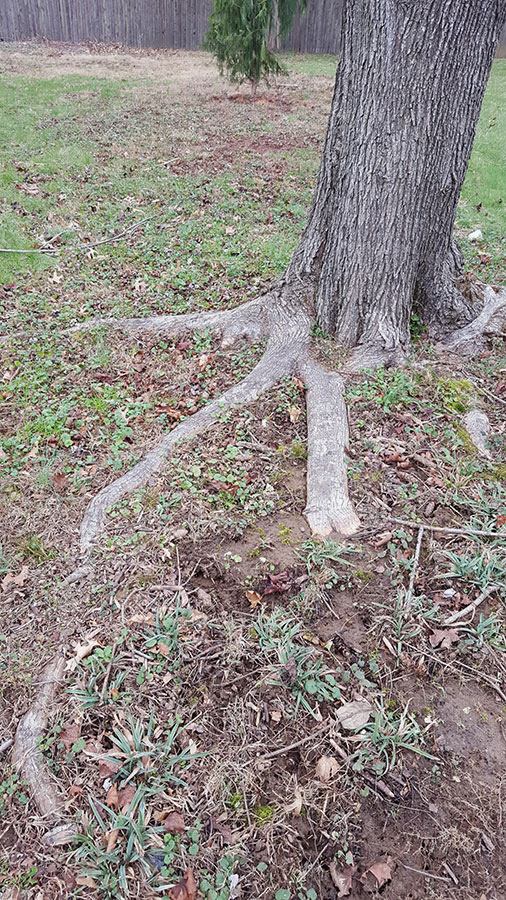
Planning your course layout is typically the most difficult step. Walk your entire area and pick out certain features that you would like to include. The things you’re looking for are elevation changes, clusters or lines of trees, tree roots, fallen trees, natural depressions, flower beds, rocks, or anything that would make an interesting field of play. If your area is lacking interest, don’t be afraid to make your own. A simple rock wall or a cluster of branches can lead to interesting areas, even on the flattest surfaces.

Once you have your Points of Interest or (POI) identified, you can began laying out your course. Pick which POIs will be landings and work backwards. Remember, what makes a good Stones course is diversity. To achieve diversity, use length and width and POIs to make sure each stretch differs from the next. Add your borders and you are ready to go.

The last step is the most fun. Play your backyard Stones course. No layout is perfect right away. Try different things, and if you find it’s too difficult to establish a stone in some areas or if stretches are always played the same way, don’t be afraid to change it up. You’ll be surprised how changing the location of a border, or adding a log, will change how a course is played.

Good luck, and feel free to contact us with questions about building your Stones course. We’ll be glad to help!
custom stones iceman top gun

Tagging: How To Customize Your Stones Set

Currently, stones can be purchased in sets that come in black, white, red, or blue. However, with a couple cans of spray paint and a little creativity, the sky’s the limit as far as what you can do with the appearance of your stones.

It all began in 2013, when Sean Smiley, an Irish-American, painted shamrocks on the side of his balls. They weren’t pretty, but this primitive paint job started a bit of a trend, and later paint jobs became much more technical and of increasingly better quality. In 2014, while headed to Toronto, Ontario, for the yearly Canada Open, Ryan Kinka felt so obliged as to spray paint his stones like the American flag. With one set of four painted with the red and white stripes and the other set blue with white stars, his team was prepared to represent the US while north of the border. The next year, when Philadelphians and co-founders of Stones, Chris Kinka and John Janick headed to New York to face off against the other founders of the game, they entered as the enemy, and only stones painted as Death Stars would do. Now, Stones veteran, Tommy “Iceman” Pendergast, has his set painted like the helmet of his Top Gun namesake and others are experimenting with skulls, and playing dice.

It’s relatively easy to do. Once a set of stones is weathered from a season or so of use, lightly sand them down and fill all large nicks with bumper repair. Then, choose your colors of spray paint. (We have found that Rust-Oleum Ultra Cover Paint and Primer works the best.)  After selecting the base coat color, spray the stones with three coats, allowing adequate drying time between coats. Next, tape off the stones in whatever design you choose and spray them with three coats of your second color choice. Repeat this step for however many colors you choose. Once satisfied with the appearance of your stones, remove tape and apply 4-5 coats of high gloss Rust-Oleum clear coat to complete the project.

As Stones spreads throughout Philadelphia, we are excited to see what ball tagging ideas surface. We envision designs that represent different neighborhoods, different streets, city landmarks, Philly Sports teams… who knows? The stones are in your court. Legal graffiti. Spray away.

Size Matters: Philly Stones

Size Matters

Does size matter? In certain circumstances, this is a hotly-debated question. In the game of Stones, not so much. In your bucket sits four stones: one at 90 millimeters in diameter, two at 100 millimeters and one at 110 millimeters. While the difference is subtle, size definitely does matter. During each round of play, two of your four stones are thrown. Which two you choose could result in the difference between scoring 6 points or watching your opponent do so. Choose wisely.

All things being fairly equal (a semi-level playing field, no low hanging branches etc.) it is probably best to throw your two 100mm stones as often as possible to get fully accustomed to their size and weight. These are your “go to” stones and in most cases do quite well. Also, unless there is some strange circumstance where you would throw a big (110 mm) and a small (90mm) as your two stones (very rarely advisable) , you will have to throw at least one 100 mm stone each and every round. Knowing this stone well will be of great service to you. With beginners, it is recommended to throw 100 mm stones exclusively for a few games until you have a solid handle. Only then are you ready to go next level.

The game of Stones does not always follow the ways of our modern world. Big is not always better, and there are plenty of times when you really must go small. Because this game is often played within tight spaces, sometimes the 90 mm stone is the only one that will fit. Skinny pockets between rocks or a sliver of a space between tree roots may be the best play and in these instances–that is when the 90 needs to come out of your bag. There may also be situations where a number of your opponents’ stones are clustered around the target stone (the mark) but a few inches of space remain, or the opponent’s stone sits a few inches away from a boulder and you literally need to stick your stone between a rock and a hard place. These are the obvious examples of when the 90 mm stone is your best bet. However, there are much more subtle and harder to notice instances when the 90 is best as well. These occasions will take time and plenty of practice to identify. They have everything to do with slope. A heavier ball will travel much farther on a downward slope than a lighter one. If the mark stops midway down a decline or is perched just at the top of a small hill, the light 90 may give you your best chance to stick your ball in close proximity the mark. It also has the best chance of getting stopped in its tracks by a twig or pebble on such precarious shots. The 90 mm stone is a special one, but you should also recognize its limitations. Stones is a game of high contact. Stones are always intentionally striking stones.   When this occurs, the smaller the ball the worse it will fair and the farther it will get knocked away.

Stones: Size MattersSo concerning stone to stone contact, a critical element of the game, the bigger the stone the better. The 110 mm stone is your “bomb” or your “wall.” If a cluster of opponents’ stones surround the mark with no room for you to penetrate, and you have one stone remaining, you just might want to blow the whole thing up by dropping your large, heavy 110 on the whole cluster. The sheer size of these stones makes them challenging to move as well. They are useful early in rounds to create virtually immovable barriers between the mark and your opponent. These monsters also fair well when thrown through heavy grasses or light tree branches. While smaller stones may not get through, these guys generally clear their own path. Much like the 90, the 110 is not perfect. Their size can make them a bit more unwieldy, so expect a slight reduction in accuracy when they leave your hand.

When the hard decision to choose the right stone needs to be made, recognize that it is not rocket science. This is a basic game that follows the most basic laws of physics. Remain logical and your stones will take good care of you.

Philly Stones Fairmount Park Course

December 12 Volunteer Day in Fairmount Park

The first public Stones course is coming to Philly in 2016! Thanks to the Philadelphia Commission on Parks and Recreation’s Pitch Your Passion Philly contest, we’ve been given the go-ahead to construct a course in a wooded area near The Boxers Trail in Fairmount Park.

The first step will be clearing the area of invasive shrubs and vines, including Oriental bittersweet, Asian honeysuckle, and multiflora rose. If you’d like to be a part of building something special, please consider joining us from 10:00 AM – 12:00 noon on December 12, 2015. Email us at info@phillystones.com for details if you’re interested in lending a hand!

Stones Philly Open 2010

The Three-Headed Monster – An Essay on Stones, By Chris Kinka

We play games. Whether it is strictly for entertainment purposes, to pad one’s ego by winning, or to fill time, we all play games. These games we play come in every shape and size. We play them by ourselves, against another, in pairs against other pairs, or with groups of people against another group. We play them inside or outside. Some involve gross physical movement while others are relatively sedentary affairs. Some are more of a mental challenge, some more physical, and most are some combination of both. Games, in all of their varieties, are as much a part of the human experience as anything else. To be human is to play them.

With all that could possibly constitute a game, it seems that there must be something that is in opposition to the player. This could be another player, it could be the puzzle itself that needs to be solved, or it could be one’s own mind. For instance, in chess, a player is trying to outwit his/her opponent. The opponent serves as one point of opposition. There is another though. If the player’s chess opponent seems to be a superior, the player must not allow themselves to be intimidated. They have a mental battle going on against both the opponent and against themselves. The same can be said of the reverse scenario. If the player’s chess opponent is deemed inferior, then it is easy for the player to let down their guard, play too relaxed, and then make a costly error. Chess is a game against two opponents simultaneously.

Then there is golf, a game that is equally as much of a mental challenge as it is a physical. In both, the opposition is still just one’s self. The self is the first point of opposition. Then, there is the golf course itself, with its rolling hills, thick fringe grasses, water hazards, sand traps, and sloping greens. A player may be in control of themselves, but a given course may prove too mighty of a challenge. These are a golfer’s two opponents. Now golfers may say that they are in constant competition with the other golfers in their round. This is true, in a way, but not directly. A golfer may play well, conquer a course and lose a round to another who played better. In this case, they lost to their opponent, but the opponent did not directly affect their round. The opponent did not knock the player’s golf ball away or stand in the player’s way, obstructing his/her vision. If the opponent’s masterful play affected the player’s round, it was that the player let it get to their head and they lost their own mental battle.

Most team sports such as football pit groups of players against another group both physically and mentally. This type of opposition is apparent, as players on both teams are engaged with each other physically and affect each others’ physical movements. This is also a mental game, as players are often battling with themselves, specifically after mistakes are made. One mistake often leads to another as they begin to “overthink.” The field, however, is flat, with uniform boundaries and a fairly uniform playing surface. This typically does not serve as much of an obstacle. This can change when mother nature gets involved. Strong winds, heavy rains and snow can quickly turn a benign playing surface into a fierce point of opposition. On days like this, players of these types of games clearly face three distinct opponents, but this is a special circumstance. It is not everyday that the football player faces the three-headed monster.

This brings us to the game of Stones. Once you play it, it becomes quite clear that the three-headed monster is staring you down every single game. Much like other games, it is critical that players keep their mental edge and confidence. A few bad throws and confidence can dwindle. The issue with stones is that even a strong throw that hits right where a player is aiming can become worthless as either the course does something nasty with it or the opponent does. The courses, as obstacle-laden as any golf course, can prove to be a ruthless opponent. Its steep slopes and unpredictable surfaces can quickly take a throw that appears on target and send it well off course and into the bottom of a body of water. Hanging tree branches and uneven footing constantly force players to throw in ways that are unnatural. Boulders, tree trunks and other visual obstructions make certain throws a mere guessing game. While players may enter a game as confident as could be, the course itself could quickly steal it. Then, of course, there are times when one believes that they have conquered their own mind and the course. They have thrown a perfect ball that even a great distance away is kissing (touching) the mark. In golf, this is equivalent to the tee shot on a par 3 that comes to rest at the edge of the cup. The throw seems perfect, but in this game, the monster can rear its third ugly head. After a player’s masterful shot, their opponent can throw one better, striking the player’s ball with their own, dislodging it from its spot and sending it well out of play. Right when a player thinks he/she has slain two of the heads, the third appears and conquers the player.

Imagine golf where your perfect approach shot could be knocked away by your opponent. Imagine football played on a field of stones, hills, and valleys. The three headed monster does not exist in most games. It does however, in Stones.

Philly Stones League 2015 Season Begins

Our first event of the season started with the West Chester Invitational.  A field of 20 players participated in a pool play style event then an seeded single elimination bracket.  In the end, the 2014 Champs Ryan Kinka and Tom Pendergast were able to defend their title and become the first back to back champs in the event’s short history.